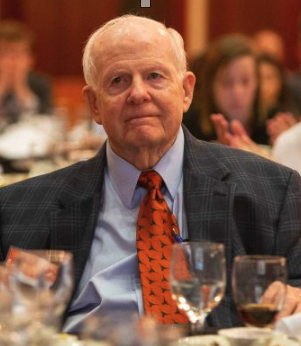
Memorial services are pending for S. Griffin Singer, a towering figure in Texas journalism education, who mentored generations of reporters and editors at the University of Texas at Austin.
He died at the age of 93 on Wednesday, March 25.

Singer, who spent more than three decades on the university’s journalism faculty, was widely remembered not only for his longevity but for his deep, personal impact on students and the profession.
“Griff made a difference in the lives of thousands of students, providing firm but gentle advice and critique to all,” said John Reetz, president of Friends of The Daily Texan, where he served as a longtime board member. “Griff deeply cared deeply about The Daily Texan and its student journalists; his former students became lifelong friends.”
Griff was awarded the Friends group’s first Lifetime Achievement Award for his support of student journalism.
In January Singer was hospitalized after being diagnosed with an aggressive form of malignant lymphoma. The illness quickly led to complications, including pneumonia and severe breathing problems. Despite beginning chemotherapy, his condition deteriorated rapidly.
Singer joined the UT faculty in the late 1960s after a career in professional journalism that included reporting and editing roles at major Texas newspapers such as The Dallas Morning News. At the university, he became a central figure in the journalism department, serving as associate chairman and leading the newspaper studies program.
In the classroom, Singer was known for his rigor and precision. He taught courses ranging from reporting and copy editing to page design, while also helping guide the school’s transition into digital journalism through early adoption of computer-assisted reporting techniques.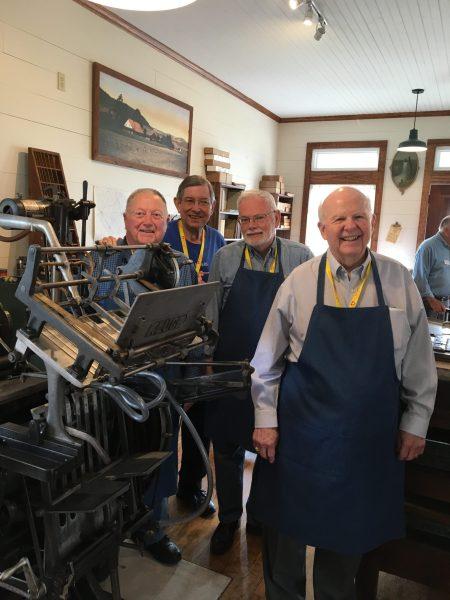
Beyond formal teaching, Singer maintained a close relationship with The Daily Texan, where his influence helped shape generations of student journalists. Former students frequently described him as demanding but deeply supportive—a mentor who pushed them to meet professional standards while investing personally in their success.
His contributions were formally recognized at the university through the naming of the Griff and Evelyn Singer Journalism Foyer in UT’s Belo Center, honoring both his career and the couple’s enduring support of journalism education.
Over a career spanning more than six decades in journalism and academia, Singer became a quiet but powerful force in the field—less known to the public than to the many journalists he trained, advised and inspired.
Griff was a master of everything journalism-related that he touched: he was a printer, a reporter, an editor, a teacher and newspaper consultant.
In his teaching career at UT, Singer taught courses in reporting, copyediting, newspaper layout, and design. He made the transition from hot type to computers to digital during that time and organized and team-taught the first offering of computer-assisted reporting and later sports reporting. Singer holds Bachelor of Journalism (1955) and Master of Arts in communication (1972) from UT Austin.
While an undergraduate student at UT, he was a reporter and day editor for The Daily Texan for two years. Then at 6 p.m., five nights a week, he changed from a clean shirt and pants and donned jeans, a T-shirt and printers’ apron to work as a printer in the composing room of The Daily Texan.
His first journalism job after serving out his Army Reserve commitment was news editor at the Arlington (Texas) Citizen-Journal (1956-59).
A long-time goal was to work for his hometown paper, The Dallas Morning News. Singer was offered a job as a general assignments reporter in 1959. His general assignments grew into covering county government and civil and criminal courts, and in early 1961 he was named an assistant city editor.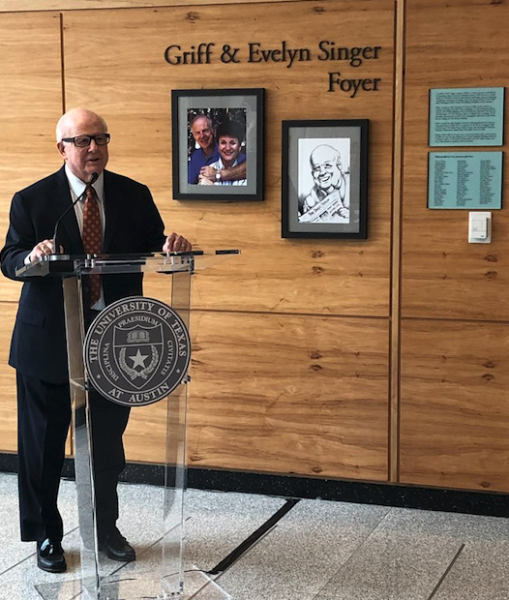
Griff was working at the Morning News when President Kennedy was assassinated and helped direct coverage of the Kennedy assassination and its aftermath, including the investigation and the Jack Ruby trial. He was in a lead editorial role helping manage the newspaper’s coverage of one of the biggest breaking news stories in American history.
Singer stayed with the News until 1967, when he returned to UT and Austin to teach in the School of Journalism. In 1979, Singer accepted the job of city editor and later an assistant managing editor at the San Antonio Light, the Hearst newspaper later rolled into the San Antonio Express-News. He returned to UT in 1981 and continued teaching and performing administrative duties in the School of Journalism.
He participated in almost countless seminars and workshops conducted for state, regional and national journalism organizations — the National and Texas Associated Press Managing Editors Association, the Texas Press Association and the Society of Professional Journalists.
He has been a judge in many state and national journalism competitions and in 1993 was one of 13 jurors selected for the international competition of the Society of News Design. For 17 summers, beginning in 1987, he was an assistant metro editor and newsroom consultant at the Houston Chronicle.
He also consulted with Freedom Communications, Inc., a California-based corporation that at the time had 26 daily newspapers.
In 1996 he was a copy editor on the Olympics Daily published by The Atlanta Journal-Constitution during the 1996 Summer Olympics. Reetz, a former student of Griff’s, was Assistant Managing Editor for News Operations at The Atlanta Journal-Constitution and brought in Griff to help publish the company’s multiple daily publications during the Olympics. “Griff worked the Olympics copy desk, fitting in perfectly, joking and working hard under demanding deadlines with his colleagues from 16 Cox papers,” Reetz said. “He made many friends in Atlanta. For all he had done for me, it was great to see him so energized and happy, in his element, on one of the best-ever copy desks.”
In 1994 was on the first team of Western journalists to go to the former Soviet state of Kyrgyzstan to work with Russian-trained journalists in adapting to a free press.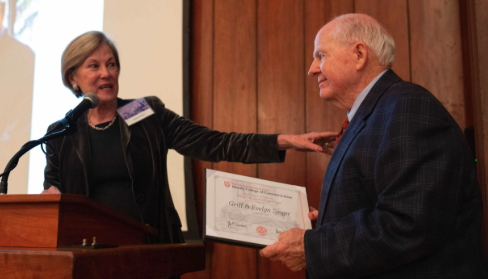
The Texas Associated Press Managing Editors Association in 1998 cited Singer for his service to journalism in Texas by presenting him with the Jack Douglas Award that honors a former editor of the Fort Worth Star-Telegram.
In 2003, he was awarded the title of “Wirehandler for Life,” for his many years of participating in the annual Texas Associated Press Workshops for editors and copy editors.
In 2016 he was inducted into the Texas Newspaper Foundation Hall of Fame. Two years later, he was inducted into the Friends of The Daily Texan Hall of Fame. Its members include Walter Cronkite, Karen Elliott House, Bill Moyers, and Lady Bird Johnson. That same year, former students, colleagues and friends established a fund creating the Griff and Evelyn Singer Foyer on the third floor of the Belo Center for New Media on the UT campus. This is the entry and gathering area for students of the UT School of Journalism.
The South Texas Press Association, the largest regional press group in the United States, in 2010 named its general excellence award The S. Griffin Singer General Excellence Award, noting his continued call for improvement in community journalism.
He served 17 years as director of the Dow Jones News Fund’s Center for Editing Excellence at UT. His UT career was centered in the classroom, working with upper-division journalism students, helping them master professional skills in writing, editing and design.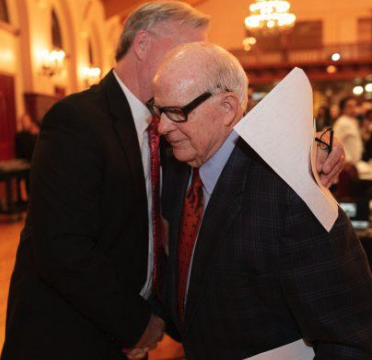
This is where he fostered long lasting relationships with many students. He also served as associate chairman and head of newspaper studies for many years.
“Griff was committed himself to having journalism reflect the wide array of faces in our country,” said former co-worker and Texan Hall of Fame member Fernando Dovalina. ” That meant training, supporting, finding jobs for and extolling African American, Latino American, Asian American and female journalists. In selecting Friends of the Daily Texan Hall of Fame honorees, he sought my help in finding such candidates.
“In my own case, he recognized my accomplishments as a pioneering Mexican American at the Daily Texan and three Texas metro papers, beginning in the 1960s.”He selected me for the Griff Singer Award. I am so proud that my name is forever connected to his.”
Cliff Avery, founding President of the Friends of The Daily Texan said, “A lot of Griff’s former students—including me—will remember him as a father-figure, because he taught us how to get along in the world, the way a father does. A father may instruct on how to polish shoes or how to bait a hook. Griff taught us answer the newsroom phone before it rang three times and how to use a Criss-Cross Directory and how to whittle a lede.
“He wasn’t one of those profs who contemplated the number of syllables or mulled how the concept of a story fit into McLuhan’s universe. He was hands-on, roll-up-your sleeves, pull out the soft lead copy editor’s pencil and use the glue pot if you needed to shift some grafs around. And never, goddurnit never, let the reporter get in the way of the story.
“He told me once that all his teaching was designed to get us ready for that first day on the job, whether the newsroom was in New York or New Braunfels,” Avery said. “He knew—from experience—that each city editor, each slot editor and each community had their own peculiarities that would need to be navigated. He got us as ready as he could. Just like a father.”
Griff, while working at the Houston Chronicle, served as the primary line editor and rewrite in the early days of the tragic story of Andrea Yates, the mother who drowned her five children.
While at UT, he served on the board and head of the Executive Committee of Texas Student Media (formerly known as Texas Student Publications). He helped guide the organization into the modern era of printing, transitioning from hot type to offset and digital publications. He was a member of the Student Rally Advisory Committee to the UT Athletic Department and sat on UT’s Dean of Students Court.
Griff has two children, Mark Singer and Cathy Becker.
-30-